How to Store Power Wheels Over Winter
Proper Power Wheels winter storage prevents dead batteries and mechanical problems. Battery care, indoor vs. outdoor storage, what to check before spring — covered.
Affiliate Disclosure
This page contains affiliate links. As an Amazon Associate, PowerWheels HQ may earn a commission on qualifying purchases at no extra cost to you. Our reviews and recommendations are editorially independent.
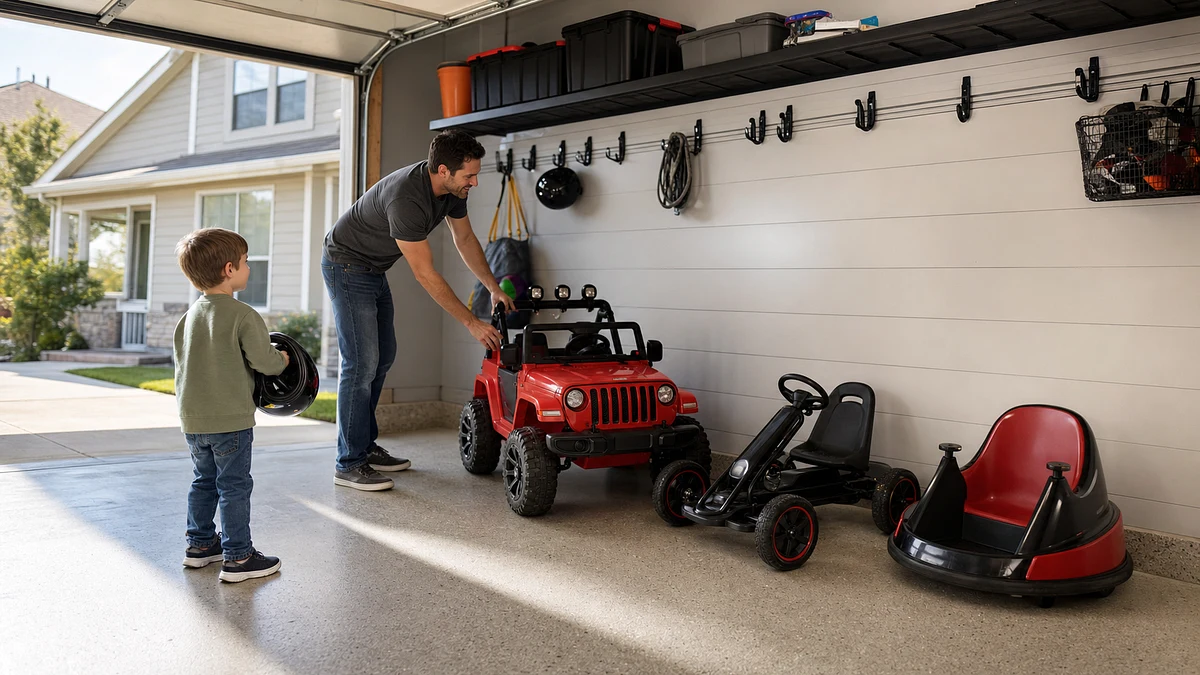
Every spring, a predictable thing happens in Power Wheels households across the northern hemisphere: parents pull the ride-on out of the garage or shed, plug in the charger, and find that the battery is completely dead — and this time, it won't come back. Four months of winter storage killed it.
This doesn't have to happen. Lead-acid batteries fail when stored in a discharged state. They don't gradually recover over spring; they sulfate, lose capacity permanently, and need to be replaced. A $35–$50 battery that should last 2–3 years dies at month 5 because nobody charged it before putting it away.
Proper winter storage takes about 30 minutes of work in the fall and five minutes of attention every six weeks. That's it. Here's what to do.
Before You Store: The Fall Checklist
Clean the vehicle before storing it. Not deep detailing — just hose it off, dry it, and remove any mud or debris from the wheel wells and undercarriage. Debris left on the vehicle over winter attracts moisture and can cause surface corrosion on plastic and metal parts.
Check for any mechanical issues that were minor during the season: a wheel that wobbles slightly, a connector that was intermittent, a gear that occasionally grinds. Minor problems get worse over 4–5 months of temperature cycling. Fix them now rather than discovering them on the first warm Saturday of spring.
Remove the battery or leave it in — either is fine, but if you remove it, label which connector is positive (red) and keep the connectors from touching metal surfaces.
The Critical Step: Battery Charge Level
Store the battery at full charge. This is the most important single thing you will do. A fully charged 12V lead-acid battery reads 12.6V to 12.8V at the terminals. Check it with a multimeter before putting the vehicle away.
If the battery is partially discharged from the last ride of the season, charge it fully before storage. Not "good enough" — fully. 14–18 hours on the stock charger, or until a smart charger indicates complete.
Lead-acid batteries self-discharge slowly over time even when not in use — roughly 1–3% per month under normal conditions. Over 4–5 months of winter storage, a fully charged battery will drop to around 12.0–12.3V. That's fine; it'll charge back up quickly in spring. A battery stored at partial charge can drop below 11V, triggering the sulfation process. Once sulfation begins in earnest, run time is permanently reduced.
Using a Battery Tender for Long Storage
The best solution for winter storage is a smart charger/maintainer like the Battery Tender Plus or NOCO Genius series. These devices charge the battery to full, then switch to a maintenance mode that delivers a small trickle to offset self-discharge — keeping the battery at exactly the right charge level indefinitely.
Plug in the Battery Tender in October, leave it connected to a garage outlet all winter, check it once in January to confirm it's still showing the green "maintenance" light, and unplug it in March. The battery will be at perfect health in spring.
This is not a required purchase, but if you have a toddler who will be using the same ride-on for 2–3 more years, the $40 investment extends the $35–$50 battery life significantly. The math works.
Indoor vs. Outdoor Storage
Indoor storage is better, and for batteries, it's significantly better. Lead-acid batteries lose charge faster in cold temperatures, and extended exposure to freezing temperatures can cause expansion damage to cells. A garage that stays above freezing is fine. A shed that drops to 10°F over January is hard on the battery.
If outdoor storage in cold temperatures is your only option: remove the battery and bring it inside. Leave it on a Battery Tender or at minimum on a shelf in a temperature-controlled space. The vehicle body can handle the cold; the battery shouldn't be frozen.
Covering the Vehicle
Cover the vehicle with a tarp or a dedicated cover. Not for structural protection — plastic handles winter fine — but to keep the seat dry (water sits in seat seams and causes mildew), keep debris and small animals out of the wheel wells and motor areas, and protect the electronics from repeated moisture exposure.
A cheap plastic tarp secured with bungee cords works perfectly well. You don't need a custom-fit cover unless you want one.
Spring Startup: What to Check
Before your child's first ride of the season, run through this list:
Charge the battery fully before use — even if it's been on a Battery Tender all winter, top it off with a full charge cycle.
Test voltage with a multimeter. A healthy battery after winter storage should read 12.4V or above. Below 12V suggests significant degradation; below 11.5V means replacement before the season starts.
Check all wheel connections — spin each wheel by hand and confirm it rolls freely. Debris can jam wheel hubs during storage.
Test the vehicle without a child first — short test run to confirm motor, steering, and reverse all work before loading up a 4-year-old.
Check the foot pedal switch — switches can corrode during storage. If the vehicle hesitates or won't start on the first press, clean the switch contacts with electrical contact cleaner.
Quick Comparison
Battery Tender Plus 12V Maintainer
Battery Tender
Best winter battery storage solution
- Voltage
- 12V
- Seats
- N/A
- Ages
- N/A
- Price
- $40-$55
NOCO Genius 1 Smart Charger
NOCO
Smart charging with battery recovery mode
- Voltage
- 12V
- Seats
- N/A
- Ages
- N/A
- Price
- $30-$45
Ride-On Car Cover (Universal)
Favoto
Covering the vehicle for storage
- Voltage
- N/A
- Seats
- N/A
- Ages
- N/A
- Price
- $20-$35
AstroAI Digital Multimeter
AstroAI
Testing battery voltage before and after storage
- Voltage
- N/A
- Seats
- N/A
- Ages
- N/A
- Price
- $13-$20
CRC QD Electronic Contact Cleaner
CRC
Spring startup — cleaning corroded switch contacts
- Voltage
- N/A
- Seats
- N/A
- Ages
- N/A
- Price
- $8-$15
| Product | Best For | Specs | Price | Rating |
|---|---|---|---|---|
Battery Tender Plus 12V Maintainer Battery Tender | Best winter battery storage solution | 12V · N/A seats Ages N/A | $40-$55 | 4.8 |
NOCO Genius 1 Smart Charger NOCO | Smart charging with battery recovery mode | 12V · N/A seats Ages N/A | $30-$45 | 4.7 |
Ride-On Car Cover (Universal) Favoto | Covering the vehicle for storage | N/A · N/A seats Ages N/A | $20-$35 | 4.2 |
AstroAI Digital Multimeter AstroAI | Testing battery voltage before and after storage | N/A · N/A seats Ages N/A | $13-$20 | 4.5 |
CRC QD Electronic Contact Cleaner CRC | Spring startup — cleaning corroded switch contacts | N/A · N/A seats Ages N/A | $8-$15 | 4.6 |
Prices are approximate and subject to change. Always verify current pricing before purchasing.
Our Picks — In Detail
Battery Tender Plus 12V Maintainer
Battery Tender
12VSeats
N/AAges
N/APrice
$40-$55
The definitive solution for winter battery storage. Charges to full, then maintains without overcharging all winter. The single best thing you can do for a Power Wheels battery's long-term health.
Pros
- Maintains battery health all winter without attention
- Won't overcharge
- Extends battery life by 1+ years
Cons
- Requires a garage outlet
- Adapter needed for Power Wheels connector
NOCO Genius 1 Smart Charger
NOCO
12VSeats
N/AAges
N/APrice
$30-$45
Smart charger that can also recover a mildly sulfated battery with its repair mode. Good dual-purpose tool: use it for storage maintenance and if the battery starts showing age, run a repair cycle before replacing.
Pros
- Repair mode for mild sulfation recovery
- Smart charge won't overcharge
- Compact and easy to use
Cons
- Costs more than the stock charger
- Repair mode can't save severely damaged batteries
Ride-On Car Cover (Universal)
Favoto
N/ASeats
N/AAges
N/APrice
$20-$35
Water-resistant cover sized for most toddler and child ride-on vehicles. Keeps moisture out of seat seams, prevents debris in motor and wheel wells, and generally keeps the vehicle in better condition through the storage period.
Pros
- Protects seat and electronics from moisture
- Prevents debris in wheel wells
- Inexpensive
Cons
- Fit varies — check dimensions against your vehicle
- Not required, just helpful
AstroAI Digital Multimeter
AstroAI
N/ASeats
N/AAges
N/APrice
$13-$20
Test battery voltage before storing (should be 12.6V+) and when pulling out in spring (should be 12.4V+ after charge). The quick voltage check tells you immediately if winter storage damaged the battery.
Pros
- Definitive battery health check
- Inexpensive
- Useful for other household electrical needs
Cons
- Requires basic knowledge to interpret readings
- Adds a step to the spring startup process
CRC QD Electronic Contact Cleaner
CRC
N/ASeats
N/AAges
N/APrice
$8-$15
Spray contact cleaner for cleaning the foot pedal switch and battery connectors after winter storage. Takes 30 seconds per connection and solves the intermittent startup issues that commonly appear after storage.
Pros
- Fixes corroded contact issues quickly
- Inexpensive
- Safe on electrical connectors and plastics
Cons
- Not needed if contacts are clean
- Strong fumes — use in ventilated space
What to Look For
Voltage (6V / 12V / 24V)
Higher voltage means more power, higher top speed, and better terrain handling. Choose based on your child's age, size, and where they'll ride. 12V is the most popular choice for ages 3–7.
Number of Seats
Single-seat models work for one child; two-seat designs are great for siblings or friends. Two-seaters often put more strain on the motor, so look for adequate power.
Terrain
Most 12V ride-ons handle flat grass and hard surfaces. If you have hills, rough grass, or gravel, look for 24V models with high-traction tires.
Safety Features
Look for seat belts, parental lockout switches, low/high speed settings, and parental remote controls — especially for younger or first-time riders.
Battery & Charging
Check battery life (usually 1–2 hours for 12V) and charge time (8–18 hours). Some premium models offer faster charging or higher-capacity batteries.