Power Wheels Modifications: The Enthusiast Overview
The Power Wheels modding scene explained — 18V speed conversions, rubber tire swaps, LED kits, Bluetooth audio, and paint. What is easy, what is involved, what kills the warranty, and the safety trade nobody skips.
Affiliate Disclosure
This page contains affiliate links. As an Amazon Associate, PowerWheels HQ may earn a commission on qualifying purchases at no extra cost to you. Our reviews and recommendations are editorially independent.
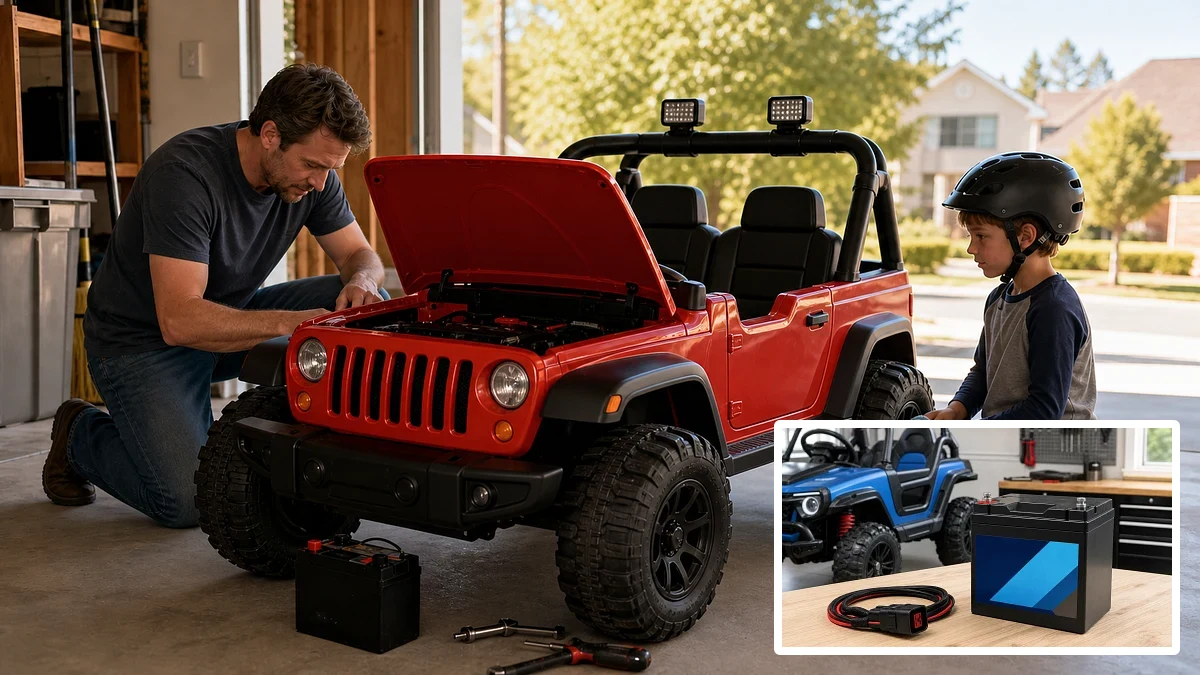
There is a thriving adult hobby dedicated to making children's cars faster, and once you know it exists you will see its fingerprints everywhere — the suspiciously quick Jeep at the park, the ride-on with knobby rubber tires, the entire Power Racing Series where grown engineers race modified kids cars around real circuits. This guide is the map of that scene: what each mod involves, what it costs, and what it costs you in warranty and safety.
One rule before anything else, because it governs every decision below: every speed mod trades stopping distance. Power Wheels do not have brakes in the automotive sense — they stop by motor braking when the pedal releases, and that system was engineered around 5 mph. Push the vehicle to 8 mph and it carries more than twice the kinetic energy into every stop, on the same plastic gears and the same plastic tires. Modders manage this with grippier tires, throttle-side discipline, and terrain choice. Ignore it and the extra speed finds a fence.
The Easy Tier: An Afternoon and a Screwdriver
These change the experience without touching the drivetrain, and they are where most families should start. LED kits — headlights, underglow, light bars — wire to the existing battery with basic connectors and transform the vehicle for $20-40. Bluetooth speakers or radio head units mount in the dash and end the era of the built-in demo song. Paint is the highest-effort, highest-reward cosmetic: plastic-adhesion primer, spray coats, clear coat, and a faded hand-me-down becomes the coolest vehicle on the block. None of these void anything meaningful or add any risk.
The Middle Tier: The Classic Mods
The 18V conversion is the gateway drug of the entire hobby. Swap the stock 12V battery for an 18V pack — the popular route is a cordless-drill battery (DeWalt, Milwaukee, Ryobi) with an adapter plate, which adds fast charging as a side effect — and the vehicle picks up roughly 50 percent more speed. The stock motors tolerate it; the stock gearboxes tolerate it for a while, which is why experienced modders add an inline fuse (a must, not an option) and keep a spare gearbox. Understand clearly: this voids the warranty the moment you splice a wire, and it is the mod that most demands the stopping-distance rule.
The rubber tire swap is the other pillar, and honestly the better first drivetrain mod: traction bands or full rubber tires fix the single worst stock behavior — plastic wheels spinning uselessly on grass — improving both go and stop. Pair it with quick-connect wiring upgrades and better switches and you have the standard enthusiast package.
The Involved Tier: Actual Fabrication
Past 18V lies the deep end: 24V conversions with motor upgrades (the 550-to-775 motor swap is the classic), reinforced or aftermarket gearboxes, brushless systems with real speed controllers, steel axles, and genuine brake additions. These builds hit 15-20+ mph, they are adult projects for closed areas or racing, and they are no longer children's toys in any meaningful sense. If your ambitions point here, our battery upgrade and gearbox repair deep-dives cover the load-bearing components in detail.
The Warranty Reality
Any electrical modification — the 18V swap included — ends your Fisher-Price warranty, full stop. Cosmetic mods, tire swaps, and speaker installs live in a gray zone that rarely matters in practice. The practical rule: mod out-of-warranty vehicles. A three-year-old marketplace Jeep is the ideal donor — cheap, already depreciated, and nothing to lose. Modding a brand-new $400 Raptor is how you own an uninsured $400 project.
Where to Start
Tires first, lights second, 18V third — in that order. Tires improve safety and performance simultaneously, lights are pure fun with zero risk, and by the time you attempt the battery swap you will know the vehicle, the kid, and the terrain well enough to make the speed trade responsibly. The table below covers the best base vehicles for the hobby, because platform choice matters more than any single mod.
Quick Comparison
Dune Racer Extreme
Power Wheels
The definitive mod platform — the one the community builds on
- Voltage
- 12V
- Seats
- 2
- Ages
- 3-7 years
- Price
- $300-$400
Jeep Wrangler
Power Wheels
The most aftermarket support of any body style ever made
- Voltage
- 12V
- Seats
- 2
- Ages
- 3-7 years
- Price
- $280-$380
F-150 Raptor Extreme
Power Wheels
The big-body build — room for batteries, audio, and lighting
- Voltage
- 12V
- Seats
- 2
- Ages
- 3-7 years
- Price
- $400-$500
12V Kids Truck
Best Choice Products
The disposable donor — learn the hobby with nothing to lose
- Voltage
- 12V
- Seats
- 1
- Ages
- 3-6 years
- Price
- $180-$250
Wild Thing
Power Wheels
The oddball build — dual-motor tank steering invites weird projects
- Voltage
- 12V
- Seats
- 1
- Ages
- 5+ years
- Price
- $250-$350
| Product | Best For | Specs | Price | Rating |
|---|---|---|---|---|
Dune Racer Extreme Power Wheels | The definitive mod platform — the one the community builds on | 12V · 2 seats Ages 3-7 years | $300-$400 | 4.7 |
Jeep Wrangler Power Wheels | The most aftermarket support of any body style ever made | 12V · 2 seats Ages 3-7 years | $280-$380 | 4.6 |
F-150 Raptor Extreme Power Wheels | The big-body build — room for batteries, audio, and lighting | 12V · 2 seats Ages 3-7 years | $400-$500 | 4.4 |
12V Kids Truck Best Choice Products | The disposable donor — learn the hobby with nothing to lose | 12V · 1 seat Ages 3-6 years | $180-$250 | 4.0 |
Wild Thing Power Wheels | The oddball build — dual-motor tank steering invites weird projects | 12V · 1 seat Ages 5+ years | $250-$350 | 4.3 |
Prices are approximate and subject to change. Always verify current pricing before purchasing.
Our Picks — In Detail
Dune Racer Extreme
Power Wheels
12VSeats
2Ages
3-7 yearsPrice
$300-$400
The community favorite for a reason: metal frame sidebars take reinforcement well, the open cockpit gives easy access to wiring and drivetrain, the low center of gravity stays stable at modded speeds, and every conceivable upgrade has already been documented by someone else.
Pros
- Metal frame accepts reinforcement and roll-bar additions
- Open layout makes wiring and gearbox access painless
- Most-documented mod platform — every question is already answered
Cons
- Popularity keeps used donor prices higher than other bodies
- Open cockpit offers nowhere to hide tidy wiring runs
Jeep Wrangler
Power Wheels
12VSeats
2Ages
3-7 yearsPrice
$280-$380
Decades of production means the Jeep has the deepest well of guides, videos, adapter kits, and precedent in the hobby. The flat body panels also take paint beautifully, making it the standard canvas for full cosmetic rebuilds of marketplace rescues.
Pros
- Deepest aftermarket and documentation of any ride-on body
- Used donors are cheap and everywhere
- Flat panels are the best paint canvas in the category
Cons
- All-plastic body flexes at higher modded speeds
- Tighter internals than the Dune Racer for wiring work
F-150 Raptor Extreme
Power Wheels
12VSeats
2Ages
3-7 yearsPrice
$400-$500
The largest current mainstream body, which is exactly what the show-build crowd wants: bed space for second batteries and speaker boxes, a big front end for light bars, and truck proportions that carry LED underglow without looking silly. The premium price argues for a used donor.
Pros
- Most physical space for batteries, audio, and lighting builds
- Truck bed conceals wiring and hardware cleanly
- Extreme trim tires are a better traction starting point than stock
Cons
- Highest donor cost in the mainstream lineup
- Extra body mass blunts the gains of a basic 18V swap
12V Kids Truck
Best Choice Products
12VSeats
1Ages
3-6 yearsPrice
$180-$250
The rational first project: cheap enough that a fried controller is a lesson rather than a loss, standard-enough internals that guides translate, and no warranty worth preserving. Learn soldering, wiring, and the 18V conversion here before touching the good vehicle.
Pros
- Lowest-stakes platform for learning electrical mods
- Generic internals mirror the standard guides closely
- Already includes remote and speed hardware to experiment with
Cons
- Thin plastic limits how far the build can sensibly go
- Weaker gearboxes tolerate overvolting for less time
Wild Thing
Power Wheels
12VSeats
1Ages
5+ yearsPrice
$250-$350
Two independently driven wheels and joystick controls make the Wild Thing the platform for the hobby's strangest builds — overvolted spinners, drift machines, robotics crossovers. Not the first project; absolutely the most entertaining fifth one.
Pros
- Dual independent motors enable mods no car body allows
- Already thrilling at stock power — small mods go far
- Compact single-seat frame keeps project scope contained
Cons
- Nonstandard drivetrain means far less documentation to lean on
- Spinning platform amplifies every safety consideration of added speed
What to Look For
Voltage (6V / 12V / 24V)
Higher voltage means more power, higher top speed, and better terrain handling. Choose based on your child's age, size, and where they'll ride. 12V is the most popular choice for ages 3–7.
Number of Seats
Single-seat models work for one child; two-seat designs are great for siblings or friends. Two-seaters often put more strain on the motor, so look for adequate power.
Terrain
Most 12V ride-ons handle flat grass and hard surfaces. If you have hills, rough grass, or gravel, look for 24V models with high-traction tires.
Safety Features
Look for seat belts, parental lockout switches, low/high speed settings, and parental remote controls — especially for younger or first-time riders.
Battery & Charging
Check battery life (usually 1–2 hours for 12V) and charge time (8–18 hours). Some premium models offer faster charging or higher-capacity batteries.