Razor Crazy Cart vs. Electric Go-Kart: Drift Toy or Driving Machine?
Razor Crazy Cart vs. traditional electric go-karts compared: what the drift cart actually is, who it fits, and when a normal go-kart is the smarter buy.
Affiliate Disclosure
This page contains affiliate links. As an Amazon Associate, PowerWheels HQ may earn a commission on qualifying purchases at no extra cost to you. Our reviews and recommendations are editorially independent.
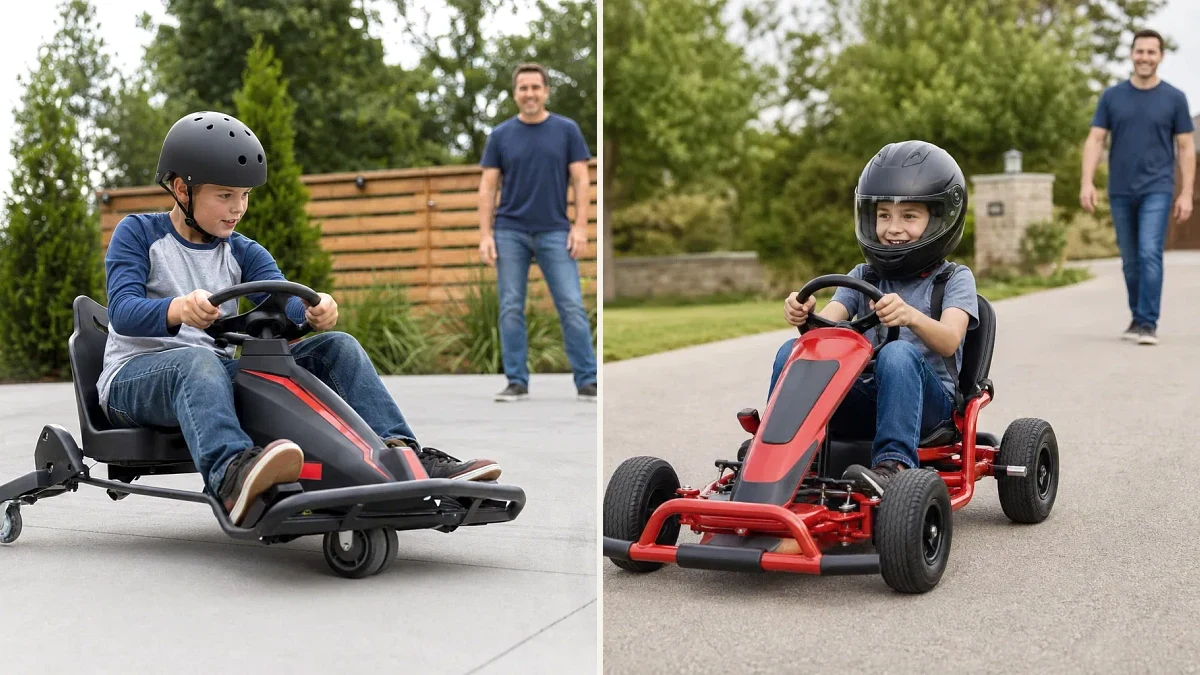
Buy the Razor Crazy Cart for a kid 9 or older who wants to drift — it's a skill toy, closer to a skateboard than a car, and it needs smooth open pavement to work. Buy a traditional electric go-kart, like the Radio Flyer Ultimate Go-Kart, for a younger kid who wants to drive. These are different purchases for different kids, and cross-buying them is how a go-kart ends up on Facebook Marketplace by spring.
The confusion is understandable: both have four wheels, a seat, and a battery. Here's where the similarity ends.
What the Crazy Cart Actually Is
The Crazy Cart's rear casters swing freely, and a drift bar lets the rider break the back end loose on demand — spinning the cart sideways, whipping through 360s, and holding controlled slides at up to about 12 mph. When it works, it looks incredible, and the kid who masters it becomes the most-watched person on the cul-de-sac.
The operative word is "masters." Drifting a Crazy Cart is a genuine skill with a genuine learning curve: expect wobbling, spinning out, and frustration in week one, competence in a month, and artistry after a season. A kid who loves learning physical skills — the skateboard kid, the parkour kid — will adore that arc. A kid who wants to turn a key and drive will be annoyed by it. Know which one lives in your house.
The other hard requirement is surface. The Crazy Cart needs smooth, flat, open pavement — an empty driveway pad, a cul-de-sac, a garage floor, a basketball court. Grass kills the drift completely, rough asphalt eats the casters, and slopes turn drills into runaway drama. No smooth pavement, no Crazy Cart. That rule has no exceptions.
What a Traditional Go-Kart Actually Is
A traditional electric go-kart is a driving machine: fixed rear wheels, real steering, predictable handling. The Radio Flyer Ultimate Go-Kart is the category's standout for younger kids — an adjustable seat covering roughly ages 3-8, and three parent-lockable speeds (about 2.5, 5, and 8 mph) so the kart grows with the driver instead of terrifying them on day one. It behaves exactly the way the kid expects: turn the wheel, go where you pointed.
That predictability is the entire point. A 5-year-old cannot use a Crazy Cart — the drift mechanics require weight shifts and counter-steering years beyond their coordination. The same 5-year-old drives a Radio Flyer confidently in ten minutes. For the 8+ crowd who wants speed without the drift learning curve, Razor's own Ground Force Drifter delivers 12 mph in a traditional low-slung kart — its slider wheels wink at drifting, but it drives like a go-kart, not a caster puzzle.
The Age Split Is the Whole Answer
Under 8: traditional go-kart, full stop — the Radio Flyer if they're 3-7. Ages 8-9 and skill-hungry: this is the crossover zone; the Crazy Cart Shift, the softer 8 mph version with a training mode, exists exactly for it. Nine and up with smooth pavement and a taste for mastering tricks: the standard Crazy Cart, and it will earn years of use. A teenager (or a parent — no judgment): the 36V Crazy Cart XL is rated to 240 lbs and marketed to adults for a reason.
The Honest Weaknesses, Both Directions
The Crazy Cart's: it's a one-trick machine, and if the trick doesn't hook your kid, there's no fallback — it's a mediocre plain go-kart at best. Sessions also run 30-40 minutes before an overnight recharge, standard for the class.
The traditional kart's: ceilings. The Radio Flyer's 8 mph and roughly 81 lb weight limit are perfect at 5 and confining at 9. Kids age out of driving in circles; nobody has ever aged out of drifting — they just move up to the XL.
Quick Comparison
Razor Crazy Cart
Razor
Best drift machine — the skill toy that defines the category
- Voltage
- 24V
- Seats
- 1
- Ages
- 9+
- Price
- $350-$450
Radio Flyer Ultimate Go-Kart
Radio Flyer
Best traditional go-kart for younger kids — grows through three speeds
- Voltage
- 24V
- Seats
- 1
- Ages
- 3-8 years
- Price
- $300-$400
Razor Crazy Cart Shift
Razor
Best bridge option — drift training wheels for the 6-9 crowd
- Voltage
- 12V
- Seats
- 1
- Ages
- 6+
- Price
- $200-$280
Razor Ground Force Drifter
Razor
Best of both worlds — a real go-kart with drift-friendly rear wheels
- Voltage
- 24V
- Seats
- 1
- Ages
- 8+
- Price
- $250-$350
Razor Crazy Cart XL
Razor
Best upgrade path — the full-size drift cart for teens and adults
- Voltage
- 36V
- Seats
- 1
- Ages
- 16+
- Price
- $500-$650
| Product | Best For | Specs | Price | Rating |
|---|---|---|---|---|
Razor Crazy Cart Razor | Best drift machine — the skill toy that defines the category | 24V · 1 seat Ages 9+ | $350-$450 | 4.5 |
Radio Flyer Ultimate Go-Kart Radio Flyer | Best traditional go-kart for younger kids — grows through three speeds | 24V · 1 seat Ages 3-8 years | $300-$400 | 4.6 |
Razor Crazy Cart Shift Razor | Best bridge option — drift training wheels for the 6-9 crowd | 12V · 1 seat Ages 6+ | $200-$280 | 4.3 |
Razor Ground Force Drifter Razor | Best of both worlds — a real go-kart with drift-friendly rear wheels | 24V · 1 seat Ages 8+ | $250-$350 | 4.3 |
Razor Crazy Cart XL Razor | Best upgrade path — the full-size drift cart for teens and adults | 36V · 1 seat Ages 16+ | $500-$650 | 4.4 |
Prices are approximate and subject to change. Always verify current pricing before purchasing.
Our Picks — In Detail
Razor Crazy Cart
Razor
24VSeats
1Ages
9+Price
$350-$450
Free-swinging rear casters, a drift bar, and up to about 12 mph of controlled chaos. This is a skill to master, not a vehicle to operate — the kids who click with it ride it for years and put on genuine shows. Requires smooth pavement and a rider with patience for the learning curve.
Pros
- Real drifting: 360s, slides, and skills that grow for years
- Deeply rewarding for kids who like mastering tricks
- 140 lb limit covers riders well into their teens
Cons
- Steep learning curve frustrates instant-gratification kids
- Useless without smooth, flat, open pavement
Radio Flyer Ultimate Go-Kart
Radio Flyer
24VSeats
1Ages
3-8 yearsPrice
$300-$400
The driving machine of the two: adjustable seat, predictable steering, and three parent-lockable speeds at roughly 2.5, 5, and 8 mph. A cautious 4-year-old and a confident 7-year-old are both correctly served by the same kart. This is what most parents actually want when they say "go-kart."
Pros
- Three parent-locked speeds stage the progression perfectly
- Adjustable seat spans ages 3-8
- Predictable handling a young kid trusts immediately
Cons
- Roughly 81 lb weight limit ends the ride around age 8-9
- No thrills left once a kid has mastered 8 mph
Razor Crazy Cart Shift
Razor
12VSeats
1Ages
6+Price
$200-$280
The Crazy Cart concept detuned for younger riders: simplified drift-on-demand rear wheels, a low-speed training mode, and a top speed around 8 mph. It answers the awkward question of the 7-year-old who wants what the big kids have, at half the price of the standard cart.
Pros
- Low-speed mode makes drifting learnable at 6-7
- Cheapest entry into the drift category
- Lighter and easier to manage than the standard cart
Cons
- Skilled kids outgrow it and want the real Crazy Cart fast
- Still needs the same smooth pavement
Razor Ground Force Drifter
Razor
24VSeats
1Ages
8+Price
$250-$350
A traditional low-slung kart that reaches 12 mph, with rear slider wheels that kick out in hard corners. It drives like a go-kart — no caster learning curve — but rewards aggressive cornering with controlled slides. For the 8-12 year old who wants speed first and drift flavor second.
Pros
- 12 mph — the fastest kart in this comparison
- Drives predictably; no skill barrier to entry
- Slider wheels add drift fun without the caster physics
Cons
- Not a true drift machine — no 360s or sustained slides
- Smooth pavement still required for the sliders to work
Razor Crazy Cart XL
Razor
36VSeats
1Ages
16+Price
$500-$650
Where the drift obsession leads: a 36V, 240 lb-capacity version of the Crazy Cart that Razor markets as much to adults as teens. Included here mostly as a promise — the kid who masters the standard Crazy Cart has a genuine upgrade waiting, which is more than any traditional kids' kart can say.
Pros
- 240 lb capacity — a genuine teen and adult machine
- Serious 36V power for full-commitment drifting
- Keeps the hobby alive after kids' karts are outgrown
Cons
- Rated 16+ — not a purchase for children
- Needs a large, empty, smooth surface to be worth it
What to Look For
Voltage (6V / 12V / 24V)
Higher voltage means more power, higher top speed, and better terrain handling. Choose based on your child's age, size, and where they'll ride. 12V is the most popular choice for ages 3–7.
Number of Seats
Single-seat models work for one child; two-seat designs are great for siblings or friends. Two-seaters often put more strain on the motor, so look for adequate power.
Terrain
Most 12V ride-ons handle flat grass and hard surfaces. If you have hills, rough grass, or gravel, look for 24V models with high-traction tires.
Safety Features
Look for seat belts, parental lockout switches, low/high speed settings, and parental remote controls — especially for younger or first-time riders.
Battery & Charging
Check battery life (usually 1–2 hours for 12V) and charge time (8–18 hours). Some premium models offer faster charging or higher-capacity batteries.