Power Wheels Age Chart: The Right Voltage for Every Age
The complete Power Wheels age chart: 6V for 1-3, 12V for 3-5, 24V for 5-8, 36V and mini bikes for 8+. Voltage, speed, and weight limits by age, plus the readiness signals that matter more than birthdays.
Affiliate Disclosure
This page contains affiliate links. As an Amazon Associate, PowerWheels HQ may earn a commission on qualifying purchases at no extra cost to you. Our reviews and recommendations are editorially independent.
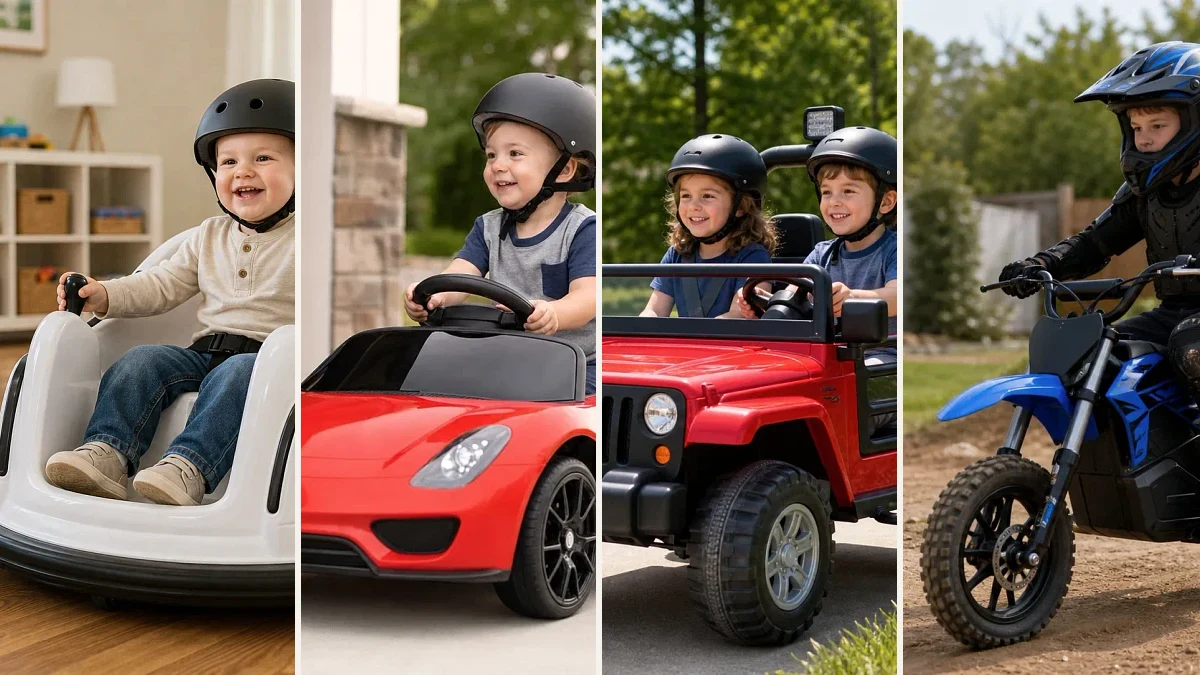
Here is the chart. Everything else on this page explains it.
- 12-24 months: 6V push-along or parent-remote ride-on. Under 2 mph. Weight limits around 40-45 lbs.
- 2-3 years: 6V, self-driven, one-button operation. 2-3 mph. Weight limits 40-55 lbs.
- 3-5 years: 12V. 3-5 mph. Weight limits 65-130 lbs depending on one seat or two.
- 5-8 years: 24V. 5-6 mph. Weight limits 100-150 lbs.
- 8 and up: 36V+, electric mini bikes, and go-karts. 14+ mph. This is no longer the toy aisle.
Voltage maps to age this cleanly because voltage is speed, and speed is the entire safety question. A 6V vehicle moves slower than a toddler can run. A 12V moves at a brisk adult walk. A 24V requires a kid who reacts to obstacles instead of riding into them. A mini bike requires actual judgment. Match the voltage to the kid and almost everything else takes care of itself.
Weight Limits Ride Along With Age
The second number on every box matters as much as the age range. A typical 6V quad caps at 40-55 lbs — fine for the age bracket, but a tall 3-year-old can hit the ceiling early. Single-seat 12V vehicles run 65-85 lbs; two-seaters run 100-130 lbs combined, which is the number to check if siblings will ride together. 24V vehicles typically carry 100-150 lbs. An overloaded ride-on is not a safety catastrophe — it is a slow, hill-stalling, motor-cooking disappointment. Kids at 90 percent of the weight limit should be shopping the next tier up.
The Readiness Signals That Beat Birthdays
Age ranges on boxes assume an average kid. Yours is not average in one direction or the other, so watch for the actual skills:
Steering with intent. Does the kid turn away from the fence before reaching it, or bounce off it and keep pedaling the pedal? Proactive steering — planning a path rather than reacting to collisions — is the signal they are ready for the next speed tier. Reactive steering means stay at the current voltage.
Brake reaction. Nearly every ride-on brakes automatically when the pedal is released. The question is whether your kid actually releases under surprise, or freezes and stays planted on the accelerator. Watch what happens the first time a dog crosses their path. Freezers need more time at lower speed, full stop.
Impulse control around others. A kid who steers wide around a younger sibling is ready for more speed. A kid who thinks chasing the sibling is the game is not — no matter how well they drive.
How to Use This Site From Here
This page is the map; the territory has its own guides. We keep a dedicated deep-dive for every age band — 2-year-olds, 3-year-olds, 4-year-olds, 5-year-olds, and the 8-10 bracket — each with full picks, and they are linked at the bottom of this page. Find your kid's row on the chart, then go read that page.
One Rule for Buying Between Sizes
Kids sit in age windows for a year or two, and ride-ons get outgrown. When your kid is at the top of a bracket — a big 4.5-year-old, say — buy the next tier with the speed locked down rather than the current tier at full price. Every 24V vehicle ships with slower selectable speeds; a 12V bought for a kid who is six months from outgrowing it does not have a higher speed hiding anywhere. Buy the ceiling, lock it, and unlock it as they grow. That single habit adds a season or two to every purchase.
The table below shows one representative pick per age band, so you can see what each row of the chart actually looks like in hardware.
Quick Comparison
Lil' Quad
Power Wheels
The 1-3 row: one button, 2 mph, nothing to get wrong
- Voltage
- 6V
- Seats
- 1
- Ages
- 1-3 years
- Price
- $90-$130
6V Toddler Quad
Kid Trax
The 2-3 row on a budget, with styling toddlers pick first
- Voltage
- 6V
- Seats
- 1
- Ages
- 1.5-3 years
- Price
- $80-$120
Jeep Wrangler
Power Wheels
The 3-5 row: the definitive 12V two-seater
- Voltage
- 12V
- Seats
- 2
- Ages
- 3-7 years
- Price
- $280-$380
Torex 24V UTV
Huffy
The 5-8 row: real 24V power for kids who outgrew 12V
- Voltage
- 24V
- Seats
- 2
- Ages
- 5-8 years
- Price
- $400-$500
MX350 Dirt Rocket
Razor
The 8+ row: where ride-on toys end and real vehicles begin
- Voltage
- 24V
- Seats
- 1
- Ages
- 8+ years
- Price
- $250-$330
| Product | Best For | Specs | Price | Rating |
|---|---|---|---|---|
Lil' Quad Power Wheels | The 1-3 row: one button, 2 mph, nothing to get wrong | 6V · 1 seat Ages 1-3 years | $90-$130 | 4.5 |
6V Toddler Quad Kid Trax | The 2-3 row on a budget, with styling toddlers pick first | 6V · 1 seat Ages 1.5-3 years | $80-$120 | 4.3 |
Jeep Wrangler Power Wheels | The 3-5 row: the definitive 12V two-seater | 12V · 2 seats Ages 3-7 years | $280-$380 | 4.6 |
Torex 24V UTV Huffy | The 5-8 row: real 24V power for kids who outgrew 12V | 24V · 2 seats Ages 5-8 years | $400-$500 | 4.3 |
MX350 Dirt Rocket Razor | The 8+ row: where ride-on toys end and real vehicles begin | 24V · 1 seat Ages 8+ years | $250-$330 | 4.6 |
Prices are approximate and subject to change. Always verify current pricing before purchasing.
Our Picks — In Detail
Lil' Quad
Power Wheels
6VSeats
1Ages
1-3 yearsPrice
$90-$130
The archetype of the toddler row. One button to go, automatic stop on release, a seat low enough for an 18-month-old to mount alone, and a top speed a walking parent beats without trying. This is what 6V is for.
Pros
- One-button operation matches toddler motor skills exactly
- 2 mph keeps every ride at supervising-adult pace
- Cheap, available 6V batteries
Cons
- Outgrown around age 3 by most kids
- 40 lb weight limit arrives early for tall toddlers
6V Toddler Quad
Kid Trax
6VSeats
1Ages
1.5-3 yearsPrice
$80-$120
Same row of the chart, different flavor: real sport-quad styling, lights and sounds, and a price that usually undercuts Fisher-Price. The right pick when the toddler in question has opinions about looking fast.
Pros
- Realistic ATV styling kids respond to
- Push-button drive with automatic stopping
- Usually the cheapest name-brand toddler quad
Cons
- Proprietary battery connector raises replacement cost
- Body plastic scuffs faster than the Fisher-Price equivalent
Jeep Wrangler
Power Wheels
12VSeats
2Ages
3-7 yearsPrice
$280-$380
The center of the entire category. Two seats, two speeds plus reverse, a 130 lb combined weight limit, and the most debugged 12V drivetrain in existence. If the chart says your kid is in the 12V years, this is the default answer.
Pros
- Two lockable speeds cover the whole 3-5 window
- 130 lb combined limit handles a friend or sibling
- Decades-proven drivetrain with parts everywhere
Cons
- Plastic tires struggle on wet or thick grass
- Kids at the top of the age range find 5 mph tame
Torex 24V UTV
Huffy
24VSeats
2Ages
5-8 yearsPrice
$400-$500
When a kid starts complaining the Jeep is slow, this is the next row of the chart: 24V, around 6 mph, genuine grass and gravel capability, and a 150 lb capacity that lasts until the vehicle stops being cool — not until it stops working.
Pros
- 24V speed and torque kids feel immediately over 12V
- High weight capacity carries big kids and a passenger
- Handles grass, gravel, and mild slopes properly
Cons
- Large and heavy — storage and moving it are real considerations
- Overkill for a cautious just-turned-5 rider
MX350 Dirt Rocket
Razor
24VSeats
1Ages
8+ yearsPrice
$250-$330
The last row of the chart is not a toy. The MX350 is a 14 mph electric dirt bike with a twist throttle and a hand brake — the standard first machine for kids who have aged out of everything above. Helmet, pads, supervision, private property. Different world.
Pros
- 14 mph delivers genuine excitement for kids bored of ride-ons
- Twist throttle and hand brake teach real riding controls
- The most proven entry dirt bike on the market
Cons
- Requires full protective gear and adult supervision
- 140 lb weight limit — bigger kids need the MX650
What to Look For
Voltage (6V / 12V / 24V)
Higher voltage means more power, higher top speed, and better terrain handling. Choose based on your child's age, size, and where they'll ride. 12V is the most popular choice for ages 3–7.
Number of Seats
Single-seat models work for one child; two-seat designs are great for siblings or friends. Two-seaters often put more strain on the motor, so look for adequate power.
Terrain
Most 12V ride-ons handle flat grass and hard surfaces. If you have hills, rough grass, or gravel, look for 24V models with high-traction tires.
Safety Features
Look for seat belts, parental lockout switches, low/high speed settings, and parental remote controls — especially for younger or first-time riders.
Battery & Charging
Check battery life (usually 1–2 hours for 12V) and charge time (8–18 hours). Some premium models offer faster charging or higher-capacity batteries.